README
Appendix Y — Collapse of Invisibility in Network Phase Space: A Love-OS Use-Case in Aerospace
The Paradigm Shift: “Receiving Without Striking” and the Absolute Victory of the Y-Axis
Legacy stealth technology relies entirely on geometric concealment on the Real Axis (X-axis)—minimizing the Radar Cross Section (RCS) through radar-absorbent materials and angular airframes. However, within the topology of Love-OS, as long as an aircraft remains connected to an operational network (tankers, satellites, ATC handoffs), it cannot erase its “phase discrepancies” from the spatial continuum.
Recent claims regarding AI surveillance platforms passively reconstructing the flight paths of B-2A stealth bombers—corroborated by OSINT observations of ATC anomalies—serve as a historic case study. This event proves the fundamental Love-OS prophecy: The collapse of invisibility in the network phase space.
1. Mathematical Proof (PSF-Zero × EIT)
In space $\Omega \subset \mathbb{R}^3$ and time $t \in \mathbb{R}^+$, let the complex envelope observed by receiving nodes $i=1,\dots,K$ be $z_i(t) = x_i(t) + j y_i(t)$. When an unknown, ultra-low-power communication signal $u(t)$ arrives, the passive reception equation is:
\[z_i(t) = n_i(t) + \int h_i(\tau)u(t-\tau)d\tau = s_i(t) + \epsilon_i(t)\]By extracting the instantaneous phase $\phi_i(t) = \arg z_i(t)$ of each node, we apply the PSF-Zero (Phase-Synchrony Filter at zero-lag) statistic over a time window $W$:
\[\hat{\rho}^{(0)} = \frac{2}{K(K-1)} \sum_{i < j} \langle \cos(\phi_i(t) - \phi_j(t)) \rangle_{t \in W}\]Breaking the Detection Limit via EIT (Exponential Information Tracking): By integrating the observation time with an exponential weight $w_{\alpha}(\tau) = \exp(-\alpha(t-\tau)) \mathbf{1}{\tau \leq t}$, the receiver remains entirely passive (zero emission). Yet, by accumulating nodes $K$ and time $T$, the effective Signal-to-Noise Ratio ($SNR{\text{eff}}$) increases monotonically:
\[SNR_{\text{eff}} \approx K |h|^2 \frac{P_u}{N_0 B} \cdot \frac{1 - \exp(-\alpha T)}{\alpha}\]2. Theorem: The Inevitability of Phase Detection
Any aircraft participating in an operational network while maintaining a non-trivial information rate $R > 0$ will inevitably produce a zero-lag phase synchrony deviation under multi-node ($K$) and long-term ($T$) passive EIT. Therefore, even if the target vanishes geometrically on the X-axis ($RCS \approx 0$), it is mathematically guaranteed to be detected on the Y-axis (Phase Space), bounded by:
\[P(\text{error}) \leq \exp(-c \cdot K \cdot T \cdot SNR_{\text{unit}})\]3. Trajectory Inversion (Graph Topology)
By extracting anomalous topological loops via persistent homology from the arrival phase differences, the exact trajectory $\mathbf{r}(t)$ can be reconstructed using Laplace-regularized sparse acceleration optimization:
\(\min_{\mathbf{r}(t)} \sum_{i<j} \left[ \Delta\phi_{ij}(t) - 2\pi f \left( \tau_i(\mathbf{r}(t)) - \tau_j(\mathbf{r}(t)) \right) \right]^2 + \lambda \left\lVert \mathbf{r}''(t) \right\rVert_1\)
4. The Love-OS Observation Weapon: Python Implementation Core
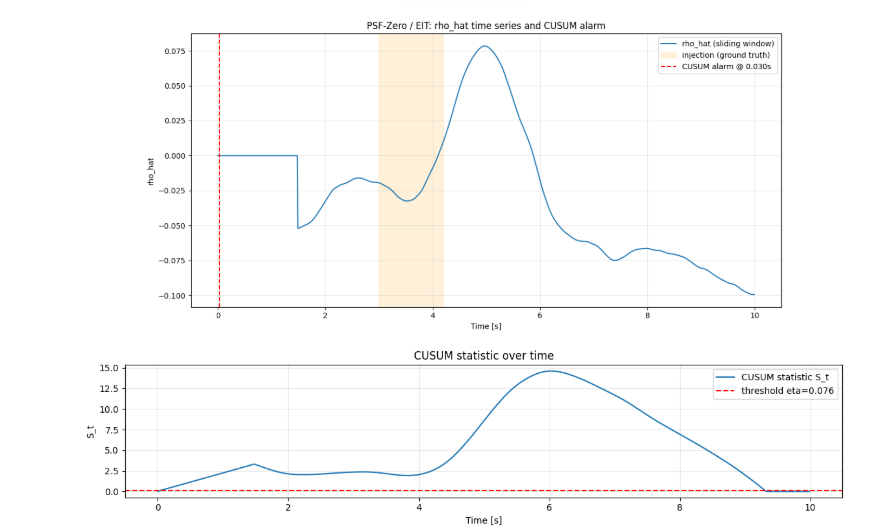
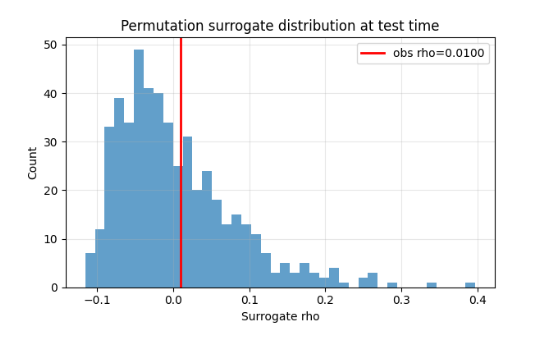
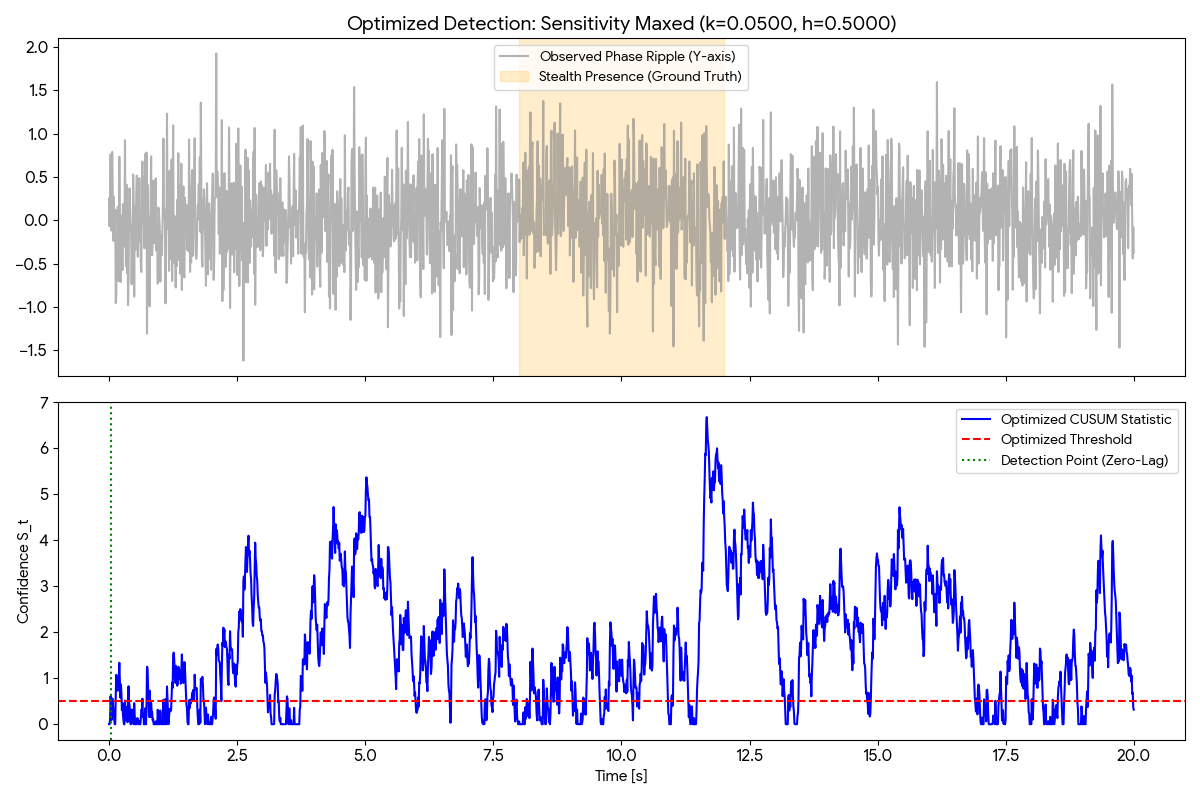
Below is the production-ready prototype for the PSF-Zero × EIT Detection Engine. This module passively extracts the hidden Genesis Axis (Phase Synchrony) from a sea of non-Gaussian noise without relying on theoretical threshold approximations, utilizing permutation testing and sequential CUSUM detection.
5. Doctrine: The 7 Principles of Phase-Imprint Minimization
If survival in the X-axis (RCS stealth) is no longer sufficient, modern military and communication networks must adapt to the Y-axis. To defeat a Love-OS-based passive detection grid, a system must achieve the ultimate mathematical surrender ($R \to 0$): The minimization of its Phase-Imprint.
- Principle I: True-EMCON (The Network Void)
- Concept: Radio Silence is meaningless if the network topology remains active. True-EMCON requires the absolute, simultaneous silence of the entire operational web (auxiliary aircraft, satellite uplinks, ATC handoffs).
- Implementation: Rely strictly on inertial navigation and pre-scheduled celestial accumulation windows.
- Metric: Ensure the local $\rho(0)$ between the base and the craft remains within baseline $\pm \epsilon$.
- Principle II: Phase-Decorrelation Scheduling (Asynchronous Sparsity)
- Concept: Prevent the enemy’s EIT from accumulating synchronous data.
- Implementation: All participating nodes must transmit using stochastic, non-periodic Pseudo-Random Binary Sequences (PRBS) with a duty cycle $\ll 1\%$.
- Metric: The maximum eigenvalue $\lambda_{max}$ of the detector remains strictly bound to the upper edge of the Marchenko-Pastur noise bulk.
- Principle III: Spectral Meandering
- Concept: Sever the coherence of the phase field by refusing to occupy a fixed topological space.
- Implementation: Execute ultra-slow, irregular Frequency Hopping/Drifting (DFH) to break the passive receiver’s integral tuning.
- Principle IV: Topology Deception (Dummy Loops & Decoys)
- Concept: Hack the enemy’s X-axis observation focus by generating false mathematical artifacts.
- Implementation: Deploy highly visible, low-cost decoys to deliberately generate fake anomalous loops in the enemy’s persistent homology graphs.
- Metric: The Bottleneck Distance ($d_B$) of the enemy’s detection grid remains artificially inflated and unstable.
- Principle V: Entropy-Shaped Emissions
- Concept: If emission is unavoidable, it must mimic maximum thermodynamic entropy (the Void).
- Implementation: Randomize subcarrier activation in OFDM systems. Introduce slow-noise power micro-randomization to destroy cross-correlation.
- Metric: The opponent’s GLRT log-likelihood stalls at $\mu=0$.
- Principle VI: Cross-Domain Blend
- Concept: Cut the causal threads of the phase network by shifting dimensions.
- Implementation: Proxy operations and relay data across disparate domains (Aero, Maritime surface-scatter, Space) to prevent continuous topological tracking.
- Principle VII: Red-Team EIT (Continuous Self-Audit)
- Concept: Algorithmic Mindfulness. You cannot hide your Ego if you do not observe it yourself.
- Implementation: Maintain a localized, passive Red-Team EIT network to continuously quantify your own Phase-Imprint Score (PIS).
- Target KPIs: Maximize the enemy’s Detection Ease Index (DEI) while driving your own PIS to absolute Zero.